Adaptive authentication
Trusted, reliable identity management service. Protect employees and sensitive data.
Benefits of adaptive authentication

Two-factor authentication
Implement granular security polices that control user access to software, hardware, and workplace apps.

Flexibility
Authentication that is flexible to your security needs, whether you want a static policy or one that adapts to your user's behavior.

Employee Benefits
Static and dynamic policies simplify and secure access so employees can work from anywhere.
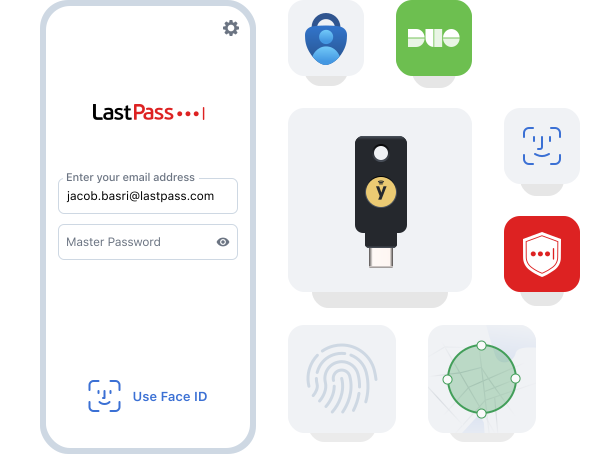
Adaptive authentication leverages multifactor authentication to simplify the employee login experience and secure administrative data. With adaptive authentication, businesses can choose the right authentication factors depending on a user's risk profile and behaviors.
Businesses use adaptive authentication by using biometric and contextual factors. A biometric factor uses something you are – a fingerprint or facial recognition – to authenticate the end user. Contextual authentication factors are factors that adapt with you.
For example, if you log into a work application on a weekday, during normal business hours, that's considered behavior of an employee. However, if there’s a login on a weekend in the middle of the night, from a new location, that is suspicious behavior.
With adaptive authentication, users must provide biometric or contextual factors to gain access.
Did you know that 80% of data breaches are due to weak or reused passwords? Unfortunately, password practices remain the weakest point in a company’s security, putting their sensitive data at risk. Yet identity management can be complex for key business verticals to use. Even as evidence continues surfacing for stronger data security, many businesses have been slow to adjust.
While the lack of investment in identity access management solutions exists, the consequences are worse. In 2017, Equifax reached a global settlement with the Federal Trade Commission after the data breach of 147 million personal customers’ info. Businesses across verticals must invest in stronger security to protect their sensitive data.
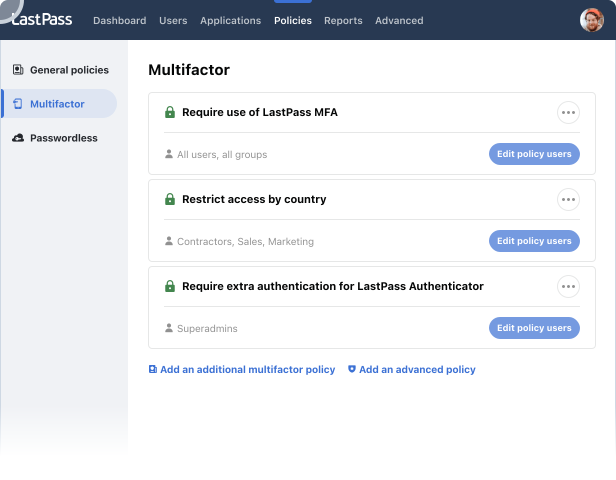
MFA improves security by requiring biometric and contextual info before granting access. Adaptive authentication extends MFA by flagging login requirements depending on a user’s profile or situation. This makes it much more difficult for cybercriminals to gain access. With adaptive authentication, businesses can add layers of security without the complexity.
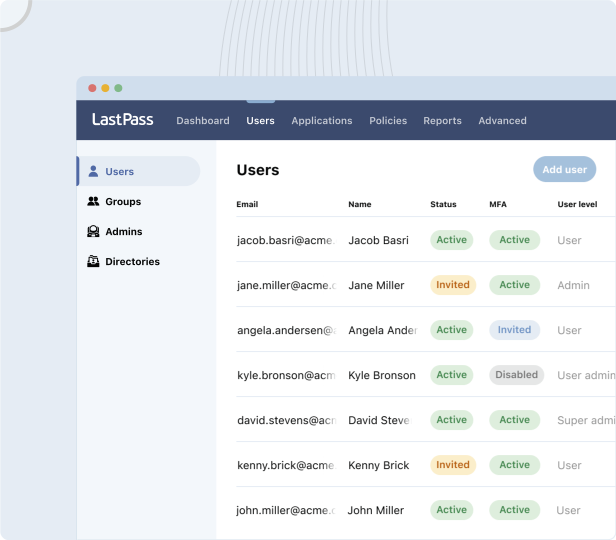
As remote work becomes the norm, employees must be able to access work applications without sacrificing security. Meanwhile, admins need to maintain control of policies without impacting ease of use.
MFA allows businesses to increase security and improve the user experience. By leveraging biometric and contextual factors, you can lock down everything, from VPNs to workstations to single sign-on apps. Reduce the risk of a successful data breach while providing a seamless login experience with LastPass MFA.
Trusted by millions, recognized by experts


100,000+
Businesses choose LastPass




With over 350 applications for a team of 3500+ employees, our risk of exposure was high and in order to comfortably enable SSO, LastPass was a vital investment as it confirms every access point and login is protected.






Explore other LastPass features

Password sharing
Securely share credentials where employees and clients require access.
Explore password sharing
MFA integrations
Configure, authenticate, and secure your on-site organization and remote Team.
Explore MFA integrations
Single sign-on
Reduce password frustrations while increasing employee access and Admin control with SSO.
Learn more about SSO
Admin controls
Manage company-wide LastPass policies, accounts and password security.
Explore admin controls